Smoke Signals, No Fire: Auditing the UK's Flame-Grilled Burger Claims in 2026
There is a particular smell that hits you when a burger has genuinely met fire. It is not the smell of a grill being switched on. It is sharper, mineral, faintly bitter at the edges, and it clings to the paper for the walk home. In 2026, that smell is rarer than the menus would have you believe. Every other burger board in the country promises charcoal, open flame or a flame-grilled finish. Many of them are selling you a typeface.
This is not a piece about liars. It is a piece about language drifting loose from the kitchen. Somewhere between the branding meeting and the flat-top, 'flame-grilled' stopped describing a method and started describing a mood. So we spent the spring eating our way through the claim: pub burgers, van burgers, delivery-first chains, a handful of properly obsessive independents. We asked one question every time, and it is the only question that matters. Can you taste the fire?
The tell is in the first bite
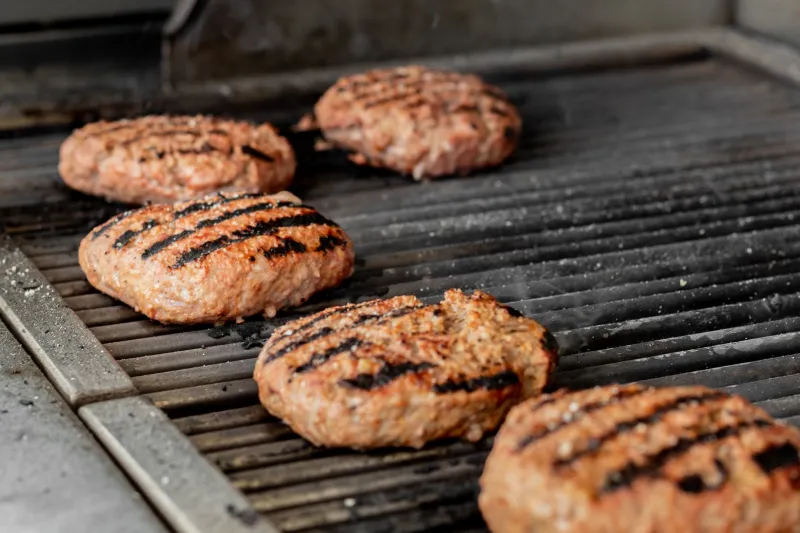
Real char is not a sauce. It does not sit on top of the patty like a coat of paint. It lives in the crust, in the little blackened ridges where the Maillard reaction has tipped over into something smokier and more savoury. You notice it at the edges first, then in the aftertaste. It makes the beef taste older and deeper than it is.
Fake char is usually one of three things: a smoke-flavoured oil, a dusting of blackened seasoning, or a few seconds under a salamander that scorches the outside without touching the middle. All three can put a dark line on a patty. None of them can put smoke in the meat. The giveaway is the texture. Real flame gives you a crust that crackles slightly and a bite that feels dry at the edge and juicy a centimetre in. The shortcut version is uniformly soft, then abruptly bitter, like licking a pencil sharpener.
What we actually tested
We kept it simple and a bit stubborn. At each stop we ordered the plainest cheeseburger on the menu, because house sauce is the easiest place to hide a lack of fire. We ate half on site, within ninety seconds of it leaving the pass. We sniffed the paper. We looked at the underside of the bun for grill marks — real flame usually leaves a little scar on the bun too, because heat travels. We noted whether the char survived the cheese, the pickle and the ride home.
Then we went back a second time and asked the question directly: what is this cooked on? The answers were more revealing than the burgers. Some kitchens were proud and specific — a charcoal bed, a wood-fired grate, a properly hot open flame with a chef who knows how to use it. Others gave us the menu word back, verbatim, like a password.
Where the fire is real
The best examples we found in 2026 were not the flashiest. A twelve-seat site in Bristol cooking over lumpwood charcoal produced a burger with a crust like a good steak and a whiff of smoke that stayed on the fingers. A Ribble Valley pub with a wood-fired grill served a patty so loosely packed that the flame had found every gap; the edges were almost frilly. A Preston van, of all things, did the most honest version we ate all year — no charcoal at all, just a very hot flat-top and a burger thin enough to char properly rather than steam.
That last one matters. You do not need charcoal to make fire taste. You need heat, contact and a cook who understands the difference between browned and burnt. The word on the menu is less important than the crust on the patty.
Where the grill is a graphic design decision
The weaker end of the market is predictable. The big delivery-first chains are the worst offenders, partly because a burger that has spent fifteen minutes in a bag will lose any smoke it ever had. But the independents are not innocent. We ate one burger described as 'charcoal-fired' that had clearly never been near a naked flame; it was grey, tight and tasted of nothing but salt and fridge. Another promised 'open flame' and delivered a patty with a single scorch mark on one side, as if it had been waved at a candle.
The tell, again, is the inside. Flame-grilled meat is rarely uniform. It has hot spots, darker corners, a bit of fight to it. If every burger leaves the kitchen looking exactly the same shade of brown, you are eating a process, not a fire.
The menu-writer's defence
To be fair to the trade, some of this is shorthand. 'Flame-grilled' has become a category word, the way 'sourdough' did. Customers ask for it. It signals a style — smoky, charred, a bit macho — even when the kitchen is using a gas grill and a lot of hope. The problem is that shorthand becomes a promise, and a promise becomes a test. If you put charcoal on the board, I am going to look for it in the burger.
What to ask before you order
Skip the word on the menu and ask a human. 'What's it cooked on?' is not a rude question. If the answer is specific — a brand of charcoal, a type of grill, a cooking time — you are probably in good hands. If the answer is a shrug and a repeat of the menu, adjust your expectations. Then do the paper test: open the wrapper and smell it. Smoke should be there before the sauce is.
The verdict
In 2026, the UK has more good burgers than ever and more meaningless fire words than ever. The two are not the same thing. Our advice is blunt: trust the crust, not the copy. Chase the places where the char survives the bun and the cheese and the walk home. Let the rest keep their fonts. We will keep our appetite for the real thing.